Homepage  > Bruchsal - live it!  > Bruchsal live it!


Baroque Palace

Schloss Bruchsal is one of the most beautiful Baroque palaces in Germany and the only episcopal Baroque residence on the Upper Rhine. The foundation stone was laid in 1722 by Cardinal Damian Hugo von Schönborn, Prince Bishop of Speyer, who made the palace the centre of his absolutist dominion.


After being almost completely destroyed in the final days of World War II, the main tract was painstakingly reconstructed according to the original design and work was completed in 1975, including the magnificent dome, Marble Hall and Prince's Hall. The staircase designed by Balthasar Neumann is considered to be an architectural tour-de-force and has been described as the "finest staircase in the world".


We invite you to a tour of the most important sights and prettiest corners of the Baroque town. We start with 50 impressive buildings and a wonderful palace garden – Schloss Bruchsal palace, which was completed in 1760. But that is not all the town has to offer. Baroque, historism and art nouveau meet in hidden corners, which can only be viewed on a guided town walk.

Baroque Palace Bruchsal
Schlossraum/Schönbornstraße

76646 Bruchsal
Tel. 07251/742661, Fax: 07251 / 742664

Mail: info@schloss-bruchsal.de,

http://www.schloss-bruchsal.de

Opening times:
Tuesday - Sunday 10 - 17 o'clock, on Mondays only at holidays, 24. /25. /31. December closed, 01 January starting from 13 o'clock opened.
Guidance: Tuesday - Sunday 11:00, 14:00 and 15:30 o'clock, group guidance according to agreement.
Admission fees:
Adults 5.00 €, reduces 2.50 €, family map 12.50 €
Groups starting from 20 persons 4.50 €/person,
per group: Tuesday - Friday 35.00 €, Saturday, Sunday, holidays 40.00 €,
in English/French/Russian 50.00 €


Today, the palace is home to the Town Museum as well as the German Museum of Musical Automata.
The Chamber Music Hall provides the impressive setting for the Bruchsaler Schlosskonzerte.

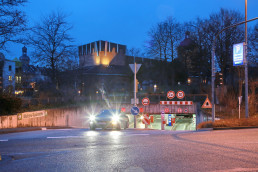
Adjoining the outbuildings on the northern periphery of the palace is the Damianstor, a gatehouse featuring a low central archway flanked by two low side wings that secures the palace grounds to the north. Happily, it was escaped significant damage on 1 March 1945 and still provides a striking entrance to the palace grounds and the town centre. The upper rooms in the gatehouse were used as a prison at one time. The two entrances at the sides are later 19th century additions.

Today, the local art society "Das Damianstor" stages various exhibitions of contemporary art in the sections of the building directly above the gate arch.

Information
Tel: +49 (0) 72 52 / 26 51
Homepage: www.damianstor.de
open: Saturday 14.00 - 17.00 o'clock
Sunday 11.00 - 17.00 o'clock


Palace Garden
The palace garden, arranged symmetrically along the axis of the main tract, was originally viewed as an outdoor extension of the living spaces inside the palace with the plants serving as a living building material. The garden was intended to reflect the power and glory of its owner, which explains the extravagant fountains and sculptures. Work started on the upper garden in 1721 at the same time as the palace. From 1760, the garden was gradually transformed into a landscaped park following the English model yet without abandoning the basic Baroque structure. Today, the palace garden continues to provide an atmospheric setting for open-air concerts and the Bruchsal Summer Festival of Music and Drama.

Take part in an guided tour through the Palace Sonderführung,
visit an Open-Air-Concert or the Summer Theatre of Bruchsal Badischen Landesbühne.


Rose Garden
The Rose Garden, designed in the Baroque style, is situated in the palace grounds and features 60 current varieties of romantic, bed and noble roses, although varieties resistant to fungal infections have been preferred. The garden was completely renovated in 2005 as a show garden where visitors can find inspiration for designing their own gardens at home.